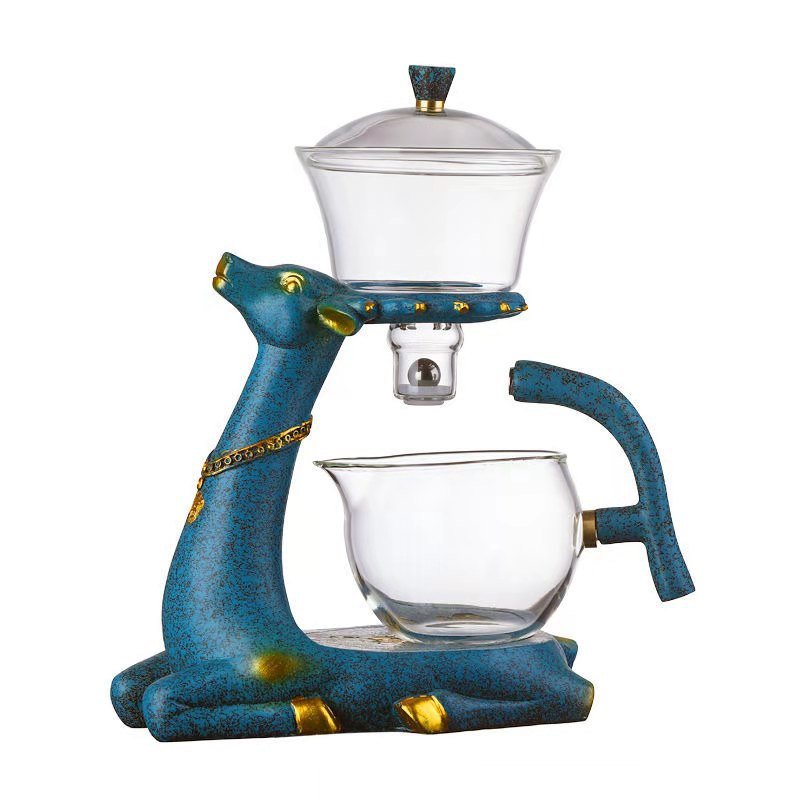
Does Kettle Material Affect Tea Taste? Steel, Glass, Enamel
A kettle is usually bought for speed, capacity or looks. Whether the material it is made from changes the tea rarely comes up — and when it does, it tends to be answered with a confident sentence and no evidence. The narrower, more useful answer is this: the material seldom changes the water itself, but it can change what the water picks up, how accurately you hit a temperature, and how quickly the water falls away from it.
It is also a claim you can test at home in ten minutes.
What a kettle can and cannot change
A kettle cannot soften hard water, remove chloramine, or alter the mineral profile that shapes how a tea tastes. Those belong to the water supply and any filter you use, and they are covered separately in our guide to water quality for tea.
What a kettle can change is narrower and more practical: the residue film on its interior, the ions a reactive metal releases into hot water, the accuracy of the temperature it delivers, and how long that temperature survives the pour.
What actually passes from kettle to cup
Three carriers do the work, and only one of them is the metal itself.
- Film. Detergent residue, cooking oils, scented soap from a shared sink, or fine scale flakes sitting in the base. A film is invisible when wet and obvious once the kettle dries.
- Ions. Reactive metals — unlined aluminium, unlined copper or brass, uncoated iron — can release material into hot water. The effect is strongest with soft water and with water left standing in the vessel.
- Heat. Thin walls and low mass lose temperature quickly; heavy walls hold it. A kettle that pours at 95 °C is doing something a kettle that pours at 82 °C is not.
Shape, colour and brand do not reach the cup.
Material by material
The table is deliberately blunt. "Inert" here means it does not contribute a taste of its own under normal use — not that it is indestructible.
| Material | Imparts taste? | What to watch |
|---|---|---|
| Borosilicate glass | No | Loses heat fast; scale is very visible; avoid sudden temperature change |
| Stainless steel (304 / 18-8) | No, in practice | Holds heat well; scale hides at the base; avoid abrasive scouring |
| Enamel on steel | No while intact | Chips expose steel underneath; chip edges trap residue |
| Aluminium | Yes, often | Reactive, especially when scratched or new; common in cheap kettles |
| Copper or brass | Only if unlined | Needs a tin or steel lining; unlined interiors react with water |
| Cast iron, unlined | Yes, subtly | Releases iron, which darkens liquor and can mute aroma |
| Glazed ceramic | No while the glaze is sound | Slow to heat, slow to lose heat; check for crazing inside |
| Plastic-bodied | Can retain odours | Hot water carries scent forward; interior scratches hold flavour |
Two rows matter more than the rest. Aluminium is the material most likely to give a thin, metallic edge to a delicate tea, and unlined copper is the one most likely to be sold without anyone mentioning that it should have a lining.
The number that matters more than the metal
Before material, look at usable capacity. A kettle is not only a heating device; it is the reservoir you pour three or four infusions from. If it is too small, you refill and reheat mid-session. If it is too large, you boil water you never use and it cools in the body.
| Kettle volume | Cups at 150 ml | Cups at 200 ml | Cups at 250 ml |
|---|---|---|---|
| 0.6 L | 4 | 3 | 2.4 |
| 0.8 L | 5.3 | 4 | 3.2 |
| 1.0 L | 6.7 | 5 | 4 |
| 1.2 L | 8 | 6 | 4.8 |
| 1.7 L | 11.3 | 8.5 | 6.8 |
For gongfu brewing the arithmetic changes completely, because cups there hold 30 to 60 ml. A one-litre kettle covers a whole session for two or three people, and a 0.6 L kettle is generous for one. The practical rule: match the kettle to the largest single pour you make, not to the number of people in the room.
Reading your own kettle
Most kettles do not announce their interior material on the outside. Four checks settle it.
- Magnet. A magnet that sticks to the body means steel or enamelled steel; cast iron sticks too. A light body that does not attract a magnet is usually aluminium.
- Weight and seam. Aluminium is remarkably light for its size. Visible rolled seams and a bright, slightly soft interior suggest an unlined metal.
- Interior wear. Scratches, cloudiness or a dull patch on the base are where residues collect, whatever the material.
- Dry-down film. Fill, boil, pour out, let it dry. A chalky line is scale; an oily sheen or a faint perfume is a film.
When the cup tastes of metal
Do not replace the kettle first. Run the isolation in this order, which costs one pot of water and one dose of tea:
- Boil the same water in a glass or ceramic vessel, brew the same leaf, and taste both side by side.
- Taste the water alone once it has cooled. Metallic water that has never met a leaf points at the kettle or the pipes, not the tea.
- Wipe the interior with a clean white cloth and smell it. A detergent or perfume note is a film, not a material.
- Repeat with low-mineral bottled water. If the metallic note disappears, your water is reacting with the vessel rather than the vessel tainting clean water.
If the note survives all four steps, the fuller diagnostic — including soapy, cardboard and musty off-flavours — is in why your tea tastes metallic.
Where the kettle genuinely changes the cup
Three situations, in order of how much they matter.
Delicate tea at low temperature. Green and white teas are usually brewed between 75 °C and 85 °C. A kettle that overshoots by ten degrees quietly turns a sweet tea bitter, and the leaf gets blamed. Our temperature and steeping chart gives the targets by type; hitting them is a kettle problem, not a tea problem.
Soft water. The softer and less mineral-rich the water, the more a reactive metal can show through, because there is less dissolved material to mask it. If your water is very soft, an inert interior is worth more than any other feature.
Long sessions. Heat retention decides whether infusion four is brewed at the temperature you intended. A heavy body holds heat; a thin glass one does not, which is why glass kettles pair better with a warmer or a quick reheat than with long gaps. The trade-offs are set out in keeping tea warm.
What is not on this list is the effect of boiling the same water twice, or of scale build-up inside the element. Both are real, and both are covered in reboiling water and tea rather than here.
What to look for when buying
- An interior material you can name — 304 stainless steel, borosilicate glass, a stated lining — rather than "premium metal".
- No unlined aluminium in anything that holds hot water for tea.
- A lid and filter that come apart for cleaning, because film is the most common cause of a strange cup.
- Usable capacity marked separately from gross capacity; the difference is often 10 to 15 per cent.
- A thermostat specification if you brew green or white tea, and a stated tolerance rather than a single set point.
- Heat-source compatibility taken from the maker's instructions, not from the shape of the base.
Material is worth maybe ten minutes of attention. Temperature control, clean interior and correct capacity are worth the rest. A modest stainless or glass kettle used well will outperform an expensive reactive one used carelessly — and no kettle on the market will fix water that is wrong to begin with.