Fairness Cup (Gongdao Bei): What It Is and Why Use It
What a fairness cup is
Most gongfu tea sets include a vessel that is neither the brewing pot nor a drinking cup: a wide-mouthed, handleless jug that sits between the two. In Chinese it is the gongdao bei, the "fairness cup". English-language sellers also call it a sharing pitcher, a fair cup or a tea sea. Its job is narrow and specific. Every infusion goes into it first, and only then into the cups.
They are usually glass or porcelain, hold somewhere between 80 and 400 ml, and are shaped for pouring rather than for steeping. Nothing about the object is complicated. What matters is the sequence it enforces.
Why one pot makes unequal cups
Pour straight from pot to cup and the tea never fully leaves the leaves. Water stays in contact with leaf while you fill the first cup, the second, the third, and extraction carries on through all of it. The first cup is the lightest. The last cup is the strongest. With two drinkers the gap is small; with four or six it becomes the difference between two different teas served from the same pot.
This is a timing problem, not a flaw in the leaf. A fairness cup turns a sequential pour into a single mixed volume. All of the infusion lands in one vessel, the concentration evens out, and the cups are filled from a uniform body of tea. The name is accurate: it makes the pour fair, not the tea better.
The effect is largest with fast-extracting teas, such as broken leaf, tightly rolled oolong that has just opened, or a young sheng pu-erh. It also compounds across infusions: if you are already working through many steeps from the same leaf, each round's drift adds to the last. Our guide to how many times you can re-steep tea covers what changes between rounds.
How to use one, step by step
- Brew in your gaiwan, teapot or magnetic brewer as usual, for the time the tea needs.
- Pour the entire infusion out of the brewing vessel in one motion. Do not leave a reserve behind to "strengthen the next one" - the leaf is already going to do that.
- Give the fairness cup a single gentle swirl. One turn is enough to homogenise the body of tea.
- Fill the cups in one pass rather than cup by cup. Going around the table and topping up each cup in turn keeps every cup within a few millilitres of the same strength.
- Empty the fairness cup before the next infusion. Residual tea left standing cools, oxidises and tastes stale against the fresh pour.
Two habits cause most of the problems people blame on the vessel. The first is pouring slowly from the pot, which defeats the purpose by letting the last of the tea steep longer than the first. The second is topping the fairness cup up with a second infusion while the first is still in it, which mixes two different extraction levels into one confusing cup.
Sizing it to the number of drinkers
A fairness cup that holds less than one full infusion forces you to brew twice to fill the table, which reintroduces exactly the timing problem it was meant to solve. As a working rule, match the cup's volume to what your brewing vessel actually yields, then check it against the number of cups you need to fill.
| Drinkers | Cups to fill | Typical volume per cup | Fairness cup to use |
|---|---|---|---|
| 1 | 1-2 | 40-50 ml | 80-120 ml |
| 2 | 4 | 40-50 ml | 150-200 ml |
| 4 | 8 | 40-50 ml | 300-350 ml |
| 6 | 12 | 40-50 ml | 450-500 ml |
These are conventions rather than standards. Gongfu tasting cups commonly hold 30-60 ml, and the "two cups per person" line in the table is a serving habit rather than a rule. If your brewing vessel is small, a fairness cup larger than one infusion is still useful: you can pour two infusions into it, but only if you accept that the second is stronger than the first and mix them deliberately.
Glass, porcelain or clay
The material changes two things you can actually perceive: how fast the tea cools, and whether the vessel carries aroma from the last tea into the next one.
| Material | Heat | Aroma | What it is good for |
|---|---|---|---|
| Borosilicate glass | Loses heat fastest | Neutral, no carryover | Watching colour and leaf; light oolong and green tea |
| Porcelain | Moderate, holds warmth longer | Neutral, no carryover | Everyday use across tea types |
| Unglazed clay | Holds heat longest | Retains aromas between sessions | One tea family per vessel, such as roasted oolong or pu-erh |
None of the three is better in general. Glass is the most informative if you are learning, because you can see the colour deepen from infusion to infusion. Porcelain is the least fussy. Unglazed clay rewards a dedicated vessel and punishes a shared one: a clay cup used for both a smoked black tea and a delicate white tea will taste of the black tea.
The cooling side effect
Pouring hot tea into a wide, unheated vessel drops its temperature by a few degrees before it reaches the cup. For green tea and light oolong that is usually welcome, since the tea is often brewed slightly hotter than you want to drink it. For aged pu-erh and roasted oolong, which are drunk hot on purpose, a thick porcelain or pre-warmed cup is worth the extra step. The mechanics of heat loss in the brewing vessel itself are covered in our brewing temperature and steeping time chart.
When you do not need one
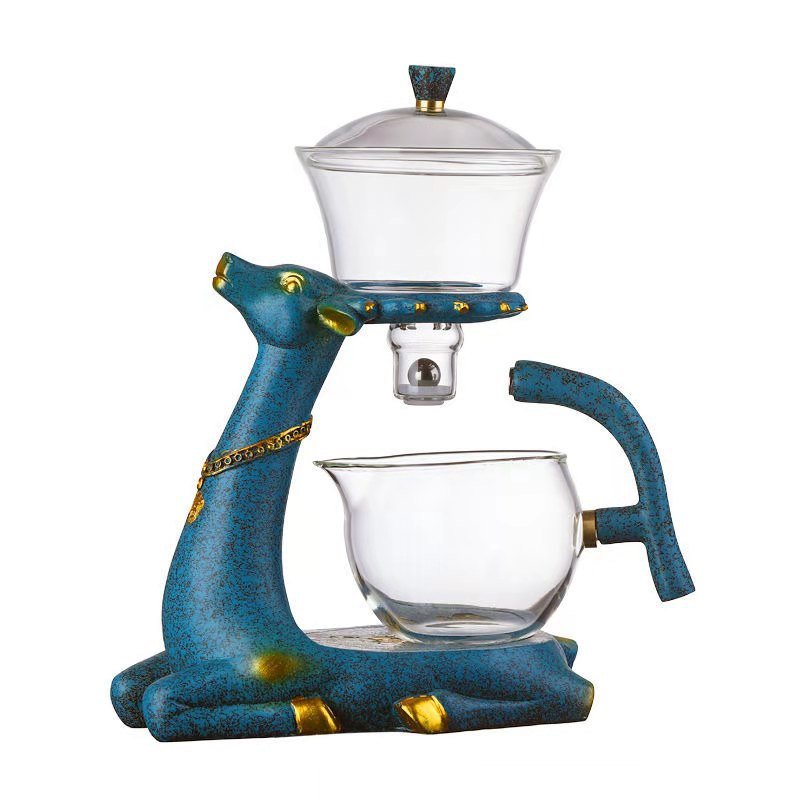
The fairness cup solves a problem created by pouring one pot into several cups. If that situation does not exist, neither does the need. A single drinker using a mug and an infuser basket has no second cup to be unfair to. Cold brew made in a bottle is already a single uniform volume. And some modern sets build the function in: with a magnetic brewer, the tea leaves the chamber through a valve directly into the serving pitcher below, which is a fairness cup with a lid and a handle. Our comparison of a magnetic set and a traditional gongfu set covers where each one fits.
Cleaning and care
Glass and glazed porcelain need nothing more than hot water and a soft cloth after each session. Tannin builds a brown film that a paste of bicarbonate of soda lifts without abrasion; hard water leaves a chalky ring that a dilute vinegar rinse removes, followed by a thorough rinse so no acid taste remains in the next pot. Skip scouring pads and abrasive powders, which scratch glass permanently and give future film somewhere to grip. Unglazed clay should be rinsed and dried open to the air, and never washed with soap, which it will absorb.
One more practical point: a fairness cup is not a storage vessel. Tea left in it for an hour is not improved by the wait. Pour it out, or drink it.
Final takeaway
The gongdao bei is not decoration and not a status object. It is a small piece of sequencing that makes a shared pot produce consistent cups, and it earns its place as soon as more than one person is drinking. If you brew alone from a single vessel, you can skip it without losing anything. If you are choosing one, buy for the volume your pot produces and the number of cups you serve, then decide the material by whether you want to watch the tea or keep it hot. For the vessels on either side of it, see our comparison of the gaiwan and the teapot and the step-by-step gongfu brewing method.